
Disclaimer: This post may have affiliate links. As an Amazon Associate, I earn from qualifying purchases.
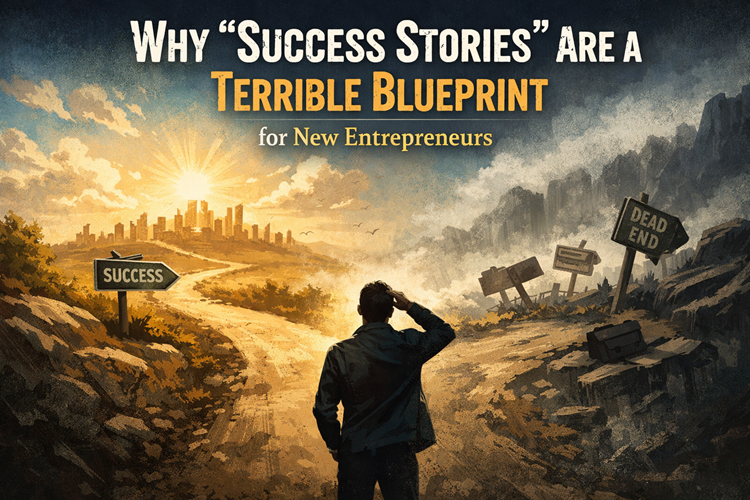
Why “Success Stories” Are a Terrible Blueprint for New Entrepreneurs
Success stories are compelling because they simplify chaos. They take years of uncertainty, compress them into a narrative arc, and present the outcome as inevitable. Struggle leads to insight. Insight leads to execution. Execution leads to success.
For someone considering entrepreneurship, this feels reassuring. It suggests that progress follows logic and that results are proportional to effort. Unfortunately, this framing is not just incomplete, it actively distorts how new entrepreneurs make decisions.
The danger of success stories is not that they are false. It’s that they hide the parts that matter most.
Success Stories Are Written Backward
Every success story benefits from hindsight. The ending is known, so the beginning is curated to support it. Decisions that were guesses become strategy. Risks that happened to pay off are reframed as calculated. Dead ends are edited out entirely.
What disappears is uncertainty and uncertainty is the environment entrepreneurs actually operate in.
When someone reads a success story, they subconsciously assume that the path was coherent while it was being walked. In reality, most founders are improvising with limited information, reacting to constraints, and revising assumptions continuously.
Reading the story forward makes it feel linear. Living it forward is anything but.
This creates a subtle but damaging illusion: that successful outcomes are the result of clear thinking applied early, rather than resilience applied repeatedly.
Survivorship Bias Isn’t a Footnote, It’s the Core Problem
We hear from the businesses that survived. We do not hear from the ones that followed the same playbook and quietly failed. This absence matters more than most people realize.
If ten thousand people attempt the same strategy and ten succeed, studying only the ten does not teach you how to succeed. It teaches you how success can be rationalized after the fact.
New entrepreneurs often assume that copying visible behaviors produces similar outcomes. They underestimate how much timing, prior experience, capital access, network effects, and sheer luck influence results.
What looks like a replicable process is often a narrow slice of a much wider distribution.
This is why success stories make terrible blueprints. They confuse correlation with causation and erase the role of variance.
Imitation Feels Productive, Until It Isn’t
Success stories encourage imitation because imitation feels safer than invention. If someone else, did it, surely, it’s possible. But imitation without shared conditions is a fragile strategy.
Entrepreneurs who follow success stories often adopt tactics without understanding why they worked. They copy channels, pricing models, content strategies, or business structures without realizing those choices were context dependent.
When results don’t appear, the assumption is usually personal failure rather than structural mismatch.
This is where confidence erodes.
Instead of asking whether the strategy fits their constraints, entrepreneurs blame themselves for not executing hard enough or fast enough. Over time, this creates unnecessary self-doubt and premature abandonment of otherwise viable paths.
The Emotional Cost of Compressed Narratives
Another hidden damage is emotional. Success stories compress timelines in a way that makes real progress feel inadequate. When results don’t materialize quickly, entrepreneurs assume they are behind.
In reality, they are normal.
Most viable businesses feel slow, ambiguous, and fragile long before they feel successful. There are long stretches where effort produces learning but not visible payoff. Success stories remove this phase entirely.
This leaves new entrepreneurs psychologically unprepared for the actual experience of building something.
They don’t quit because the business is impossible. They quit because the story they expected doesn’t match the reality they’re living.
Why Outcome-Focused Learning Fails
Learning from outcomes instead of decisions is one of the most common mistakes in entrepreneurship.
A good decision can produce a bad outcome. A bad decision can produce a good one. When we study only outcomes, we reinforce the wrong lessons.
Success stories encourage outcome-based reasoning. They focus on what worked, not why certain decisions were reasonable at the time they were made.
A far more useful approach is to study how entrepreneurs evaluated tradeoffs, managed uncertainty, and adjusted when assumptions failed regardless of the final result.
Judgment compounds. Outcomes do not.
Process Stories Are Far More Useful
If success stories are postcards, process stories are maps.
Process-focused analysis looks at constraints, decision logic, feedback loops, and adaptation. It acknowledges that the same decision can produce different outcomes under different conditions.
This kind of learning doesn’t promise certainty. It builds competence.
Entrepreneurs who learn how to reason under uncertainty are far more resilient than those who chase proven paths. They are less surprised by friction and less discouraged by slow progress.
They don’t need guarantees. They need frameworks.
What This Looks Like in Practice
Consider two entrepreneurs starting similar businesses.
One studies success stories obsessively, trying to reverse-engineer tactics. The other studies decision-making frameworks, focusing on how to test assumptions cheaply and adjust quickly.
When early efforts don’t work, the first feels lost, the blueprint failed. The second expected this and adapts.
Over time, the gap widens.
The first is always searching for a better story to follow. The second is building judgment that applies across contexts.
Reframing Success Stories Correctly
Success stories are not useless. They are just frequently misused.
They are best treated as inspiration, not instruction. They can motivate effort, but they should never dictate strategy.
A healthier framing is to ask:
-
What constraints did this person have that I don’t?
-
What advantages did they have that I won’t?
-
Which decisions were reversible, and which weren’t?
-
What risks were invisible in hindsight?
These questions turn stories into context, not commands.
The Real Blueprint Is Durability
Entrepreneurship is not about finding the right story to copy. It’s about building systems that survive uncertainty long enough to benefit from learning.
Durability matters more than speed. Judgment matters more than tactics. Adaptation matters more than certainty.
Success stories make it look easy. Reality makes it worthwhile, if you’re prepared for it.
Your job is not to replicate outcomes.
Your job is to stay in the game long enough to create your own.